

Imagine you’re a builder trying to bring more affordable homes to your community. To
make it work, you need to balance the money coming in, like loans, grants, or tax
credits, with the money going out for land, construction, and ongoing costs.
If rents are too high, families can’t afford them. If rents are too low, the project
doesn’t cover its costs without extra support. This tool lets you play with
different options to see how the pieces fit together and what it takes to close the
gap.
This calculator supports mixed-market housing models that blend market, near-market,
and affordable units to create financially sustainable, inclusive developments.
Mixed market housing combines market, near market, and affordable units in one
development to create financially sustainable, inclusive projects.
Affordable housing is rarely solved by one solution; it often requires teamwork,
creative financing, and support from governments and communities. Use this
calculator to see just how challenging (and important) it is to make projects work.
This tool is designed for housing providers, boards, municipalities, and community
partners assessing the financial viability of affordable and mixed-market housing
projects. The calculator works alongside ASCHA’s Mixed Market Housing Toolkit, which
provides policy context, case studies, and advocacy guidance to help interpret the
results shown here.
The calculator is a high-level feasibility tool. It does not replace detailed pro
formas, appraisals, or lender underwriting, but helps identify whether a project is
likely to be financeable and what supports may be required.

Canada is currently grappling with a shortage of affordable rental housing. The most
recent Canadian Census in 2021 revealed that 2.6 million Canadians live in core
housing need, meaning their current housing is either unsuitable, inadequate, or
unaffordable, and they would need to spend 30% or more of their household income to
meet basic standards.
Suitability refers to having enough bedrooms for the household's size, adequacy refers
to housing in good condition and meets the needs of the household (without major
repairs needed); and affordability means spending no more than 30% of before-tax
household income on housing.
This stark reality underscores communities' critical role in developing all housing
types, ranging from purpose-built rentals to co-operatives and mixed housing models,
particularly, when the private market is out of reach.
To bridge this gap, we must work together to address barriers that hinder the
construction of these desperately needed units.
Despite community housing's critical role in communities across the country, the
question remains: why is it so challenging to build these units, and what can we
do about it?
Below, we explore why affordable housing is so expensive to build, how it is typically
financed, and what it will take to ensure low-income Canadians can access safe, secure
housing that meets their needs.
Community Housing Units as a Share of Total Housing Units, %
How does Canada rank in community housing compared to our peer countries?
Community Housing Units per 1,000 people
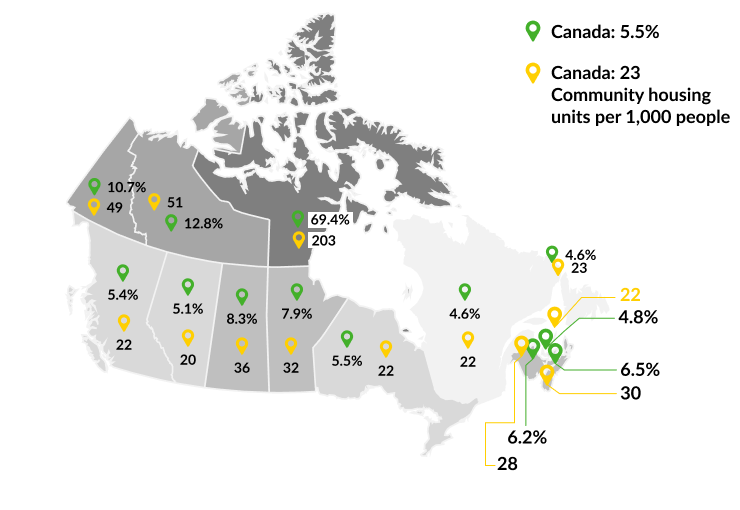 Source: The Impact of Community Housing on Productivity, Canadian Housing & Renewal
Association
Source: The Impact of Community Housing on Productivity, Canadian Housing & Renewal
Association
This shortage of affordable housing leaves many households struggling. A single parent
working two-part part-time minimum wage jobs might wait months or years for a
community housing unit. But despite this high demand, developers aren't racing to
build new affordable housing.
The challenge? Building affordable housing is not particularly affordable. There is a
persistent gap between the high cost of constructing and operating these developments,
and the rents people with low incomes can realistically pay. Without government
subsidies or other supports—which are often scarce—many affordable housing projects
simply do not "pencil out."
This interactive framework explores why that gap exists, how affordable housing is
typically funded, and what it takes to close the gap for households with the lowest
incomes in Canada.
Building an affordable housing development is expensive. Developers often borrow
heavily to pay for the land, permits and materials, all before a single tenant moves
in and starts paying rent. But if a building's projected rent income isn't high enough
to cover debt service and provide an essential return, banks and other lenders won't
approve a loan, or will only lend a fraction of the total cost.
Without external subsidies from federal programs under the National Housing Strategy
(NHS) or provincial, territorial or municipal funding streams, affordable housing
developments stall, leaving few viable options for many Canadians who need
below-market rents.
This problem is even more acute for households at the very lowest end of the income
spectrum in many regions. The rents these households can afford are too low to cover
building operations, even if the property was constructed at no cost or has no capital
debt.
Typical Example: To illustrate this, consider a mid-sized Canadian city such as
Calgary. Development costs in Calgary, including land, labour, and materials, are
significant (although they may not be as high as in other communities, including most
urban centres). The math behind building affordable units usually follows the same
formula across provinces.
Development costs a lot of money. Developers rely on loans and other sources to fund
construction before people move in and start paying rent. However, developers can only
secure those loans and equity sources if the operating income from the building is
enough to make the loan and pay returns to investors. This stops affordable housing
development before it even begins, leaving few options for the millions of low-income
families looking for safe, affordable homes.
The problem is even more difficult when you consider the lowest-income households. In
many places, lowest-income households cannot pay rental rates that cover the costs of
operating an apartment building, even if developers could build that building for
free.
Housing developments involve multiple "uses" of funds
Land (Acquisition Cost)
Land costs can be a significant hurdle. Some of these costs can be reduced if communities/governments donate or offer land at below-market prices to non-profits. But when this isn't an option, land alone can make a project financially unfeasible.
Construction
Construction is typically the most significant single line item, reflecting materials, labour and market forces. In many Canadian cities, multifamily construction costs can easily total millions of dollars, even for modest projects.
Development Fees
Developers, including non-profit housing providers, must cover their overhead, salaries, office expenses and the risks involved in bringing a project to completion. In affordable housing development, part of this fee can sometimes be deferred and repaid once rental income stabilizes, giving the project more room to cover early development costs.
Other uses include soft costs (architectural, engineering, legal fees), interim financing costs (interest on construction loans), permanent financing fees, reserves, contingency allowances, project management fees, and preparing applications for different funding streams.
Simulate donated public land >
The following significant development cost is construction. While a developer could
make some decisions to minimize construction costs, market forces largely determine
these costs.
A third use to consider is the developer fee. This fee is built into calculating the
development costs because a developer uses it to pay all the costs of doing business:
hiring staff, running an office, finding new opportunities, and more. While some
community housing providers absorb these costs, they are still quite extensive.
Affordable housing developers can defer some fees, leaving more money to cover
development costs. The developers then recoup the deferred portion of the fee as rents
are paid over time. This assumes that the gap is eventually closed, the building is
built, and it operates successfully for years.
While these are three crucial uses a developer must account for, other costs include
design fees, construction loan interest, permanent financing fees, reserves, and
project management fees.
To cover these substantial costs, developers must rely on funding sources, most commonly:
Debt
A bank or credit union loan often backed by Canada Mortgage and Housing Corporation (CMHC) mortgage insurance or financing programs (e.g. National Housing Co-Investment Fund). The loan size depends on the building's net operating income (NOI) and the money left over from rent once operating expenses are covered.
Equity, Grants and Tax Credits
Equity can come from private investors or the non-profits' reserves. Grants may be available at the federal, provincial, or municipal levels (for example, the Rapid Housing Initiative or the Affordable Housing Partnership Program in Alberta). Tax credits or similar incentives (like BC Housing's programs or Québec's AccèsLogis) are crucial. However, these resources are limited; applications are competitive, and qualifying does not mean a project will get funding.
Canada Housing Benefit or Other Rent Subsidies
Some households receive a portable rent subsidy, which allows them to find suitable housing with the cost offset by these programs. This helps cover some of the affordability gap.
Each province and territory has its own funding mechanism and housing strategies. The
diversity of policies can dramatically affect affordability and project viability from
one region to another.
Developers rely on various sources of money to cover the costs of building and
operating a housing development. One important source is debt, which they borrow from
lenders based on the amount they can pay off over time.
Though the current market affects the loan terms, developers are unlikely to get a
loan big enough to close the gap.
To demonstrate this, we look at vacancy rates, which are generally an indicator of
market strength. In a very tight rental market (low vacancy), a building generates a
more consistent income, so you'd expect a higher mortgage rate. Repricing is hard in
affordable housing and other factors can also lengthen vacancy.
Since the size of the loan is based on the future rents the building is expected to
bring in, lower vacancy rates—and the resulting increase in income—should increase the
size of the loan. Below, you can adjust the vacancy rate to see its effect on the gap.
A building's expected rent revenue partly hinges on its vacancy rate, the percentage
of units sitting empty at any given time. In a very tight rental market (low vacancy),
a building generates a more consistent income, which can justify a larger loan.
However, including minimum rent and other provisions for rents within lower funding
guidelines can limit the loan. However, even with a low vacancy rate, the maximum loan
combined with grants might not cover all costs, leaving a gap.
Another consideration is the availability of tax credits, which are a way to encourage
affordable housing development. Besides loans, there are grants, but these sources
come with very clear conditions.
If public funding isn't enough, why not just borrow more? Lenders calculate the
maximum loan using debt service coverage (DSC) requirements and interest rates. The
project's NOI must comfortably exceed the annual loan payments, so the organization is
not constantly at risk of default. Lower rents = lower NOI = smaller possible loan.
Bigger loans alone rarely solve the affordability gap for affordable housing
developments.
At this point, it's fair to ask: If there aren't enough grants or tax credits,
why don't developers take out bigger loans to get the building off the ground?
In short, lenders won't (and shouldn't) let them. A bank's loan size depends on the
project's net operating income (NOI) or the amount of money it expects to bring in
from rent after accounting for operating expenses.
Lenders use NOI to calculate how much debt a developer will reasonably be able to pay
off, accounting for interest and recognizing the developer still needs to have some
cash flow to cover unexpected expenses.
But if the rent is set at rates that a working family can afford, the NOI will be
pretty low. It might even be less than zero if operating costs exceed revenue. The
lower the NOI, the smaller the loan.
Increasing the number of units can make some aspects of development more cost-efficient (spreading land or soft costs across more units). This is often referred to as economies of scale. However, that assumes enough demand to fill them and that local zoning allows for higher density. Even with larger projects, subsidies are typically needed, primarily to support the very low-income units.
A quick path to boosting NOI is charging more in rent. Yet, when rent surpasses 30% of a household's income, it is no longer considered affordable. For developments that serve extremely low-income households, even a modest increase can make rent unaffordable, which, for many community/affordable housing providers, fundamentally conflicts with their mission. The core goal of non-profit housing organizations is to ensure low-income households have access to stable, affordable homes, not to maximize rent revenue. Instead of relying on rent increases, most non-profit housing providers focus on long-term affordability through alternative strategies, such as:
Long-term affordability requires substantial public investment, cost-efficient development models, and sustained operational support to keep rents low while covering costs.
Non-profit and Co-operative Housing
Canada has a long tradition of non-profit housing and co-ops, often supported through provincial and federal programs. Co-operatives are member-driven and strongly emphasize long-term affordability and community governance.
Housing Management Bodies (HMBs)
HMBs are designated housing organizations established under Alberta's Housing Act; they are provincial designated housing entities responsible for managing government-owned social housing units, in addition to many owning their units or, for example, operating municipally owned units. On and off-reserve communities face some of the most severe housing shortages. Federal and provincial programs are increasingly targeting funds for Indigenous-led housing solutions, but resources remain strained relative to the need.
So, if you need a higher NOI to get a bigger loan, why not add more units to your development to increase the NOI? Though this will increase construction costs, some costs, like the acquisition cost and project management fee, may remain the same or increase more slowly, helping close the gap.
If a funding gap remains after layering available supports, it indicates that
projected rents and financing are not sufficient to fully cover development costs
under current conditions.
Closing the viability gap typically requires a combination of tools working together,
including:
For the lowest-income households, particularly those in housing with on-site services or supports, both capital subsidies and ongoing rent assistance are often required to keep housing affordable over the long term.
Changes to land use, regulations, and construction methods can help narrow the
affordability gap, but they are not enough on their own. Most affordable housing
projects require subsidies to be financially viable.
Subsidies serve different purposes. Rent assistance programs, such as the Rent
Assistance Benefit (RAB), support households directly by reducing rent burdens while
allowing projects to operate sustainably. Other supports reduce upfront development
costs, including CMHC financing and capital programs, provincial funding such as the
Alberta Affordable Housing Partnership Program, and municipal tools like land
contributions, fee waivers, and property tax exemptions. Incentives for modular and
modern construction methods can further reduce costs and timelines.
No single tool can solve the affordability challenge. Closing the viability gap
requires layering development financing, municipal supports, construction innovation,
and ongoing rent assistance, particularly to serve the lowest-income households.